
Whether it’s the first time or the tenth time, ESL classroom setup can feel overwhelming. Between getting to know a new roster of students, coordinating with classroom teachers, and finding space for all your materials, it’s a lot. But a thoughtful setup at the beginning of the year makes everything that comes after so much easier.
Whether you have your own dedicated ESL room or you’re a push-in teacher working out of a cart, these five things will help you create an environment where multilingual learners feel safe, supported, and ready to learn. Let’s dig in.

1. Visual Support and a Print-Rich Environment
Create a visually appealing classroom with labels, posters, and charts that display key vocabulary words, phrases, and instructions. These visual aids help multilingual learners make connections between words and their meanings, aiding comprehension. Use a mix of colors and engaging visuals to make the classroom inviting and informative. For newcomers, display posters with ways to ask for help to get what they need, and for others, ways to ask for more information if they hear something unfamiliar.
A few practical ideas to get started:
- Label everything at student eye level – cubbies, supply bins, the door, the sink. Even if students can’t read yet, seeing print everywhere normalizes it.
- Create a “Word Wall” space that you add to together throughout the year. Starting it on day one, even with just a few words, signals to students that vocabulary is something you build together. My vocabulary posters or unit visuals might help!
- Post a visual schedule so students always know what’s coming next. Transitions are especially hard for newcomers, and knowing what to expect reduces anxiety significantly.
2. Diverse Reading Materials
Set up a designated place with a variety of books and materials suitable for different language levels and interests. Include picture books, simple readers, and culturally diverse stories including the varied backgrounds of multilingual learners. Having books available at different language proficiency levels helps students practice reading and comprehension in a supportive setting. If you don’t have space for a reading nook or corner, try to find a way to rotate a small display or basket such as on a window or whiteboard ledge.
A few tips for building your library on a budget:
- Check your school or public library’s discarded book sales – you can often find great books for less. Or check out the books to go with your current unit to supplement for free.
- Ask your students’ families! Many families are happy to donate books in their home language, which is wonderful for cultural diversity too.
- Bonus tip: Don’t stress if your library is small at first. Even a single basket of 10-15 books that students can browse independently is meaningful. Quality over quantity, especially in the beginning.
3. Interactive Learning Stations in ESL Classroom Setup
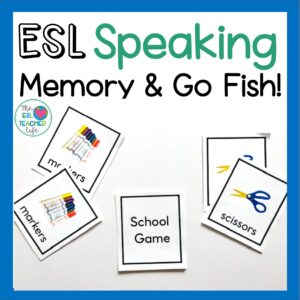
Organize different learning stations that encourage active participation and collaboration. For example, have a listening station where students can use headphones to listen to recordings, songs, or stories. Create a writing station with writing prompts, paper, visual dictionaries, and writing tools to encourage language practice. Another station could include speaking games to give students a chance to practice familiar vocabulary. The cards shown about can be used for a matching game or Go Fish! These stations are particularly helpful if you have a longer block of time, or large groups and students at different proficiency levels. This will help you to differentiate materials and meet with smaller groups while all students are actively engaged.
4. Cultural Sensitivity and Inclusion
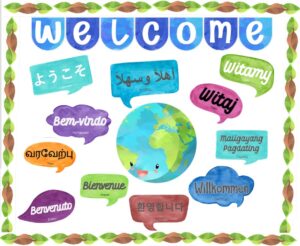
Make sure your ESL classroom setup welcomes all students. Display posters or visuals that celebrate the diversity of your students’ backgrounds. Add student photos and student work. Highlight holidays, traditions, and important events from various cultures to foster a sense of belonging and mutual respect. Be sure to check out the many wonderful resources by my friend Ayten at Language Adventurist. She has so many wonderful hello and welcome bulletin boards in her TPT store. Students love seeing their flags and languages highlighted in the classroom and around the school.
5. ESL Classroom Setup Includes a Place for it All to Belong
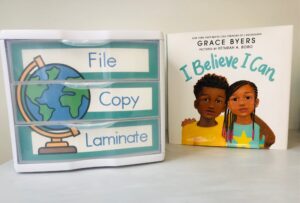
Visuals, books, learning stations and materials, and displays all need a place when you are using them, and when it is time to put them away. Be sure to account for how you are going to store your materials and have access when you are ready to use them again.
Visuals, books, games, and manipulatives are only useful if you can actually find them when you need them. Storage is the part of classroom setup that teachers always wish they’d thought about sooner.
Here are some practical storage solutions that work well in ESL classrooms:
- Clear bins with labels and picture labels – you and your students can find things at a glance, and putting materials away becomes part of the routine.
- A rolling cart is a lifesaver if you push into multiple classrooms. Organize by activity type (games, writing tools, vocabulary cards) so you’re never digging around between classes.
- Gallon zip-lock bags for game sets – cards stay together, they’re easy to store flat, and students can help manage them.
- A designated “active games” bin separate from your table materials. When it’s game time, students know exactly where to go.
Taking 30 minutes before the year starts to organize your materials will save you hours of frustration later, and it can help you feel like you have it all together even on the most chaotic days.
Frequently Asked Questions About ESL Classroom Setup
What if I don’t have my own classroom? You are not alone – many ESL teachers are push-in or travel between rooms with a cart. Focus on what you can control: a well-organized cart, a portable word wall or ring of vocabulary cards, and a small pouch of go-to supplies. You can still create consistency and warmth for your students even without four walls to call your own.
When should I start setting up? Ideally, the week before students arrive. But even one focused hour the day before school starts to lay out your key visuals and make sure your materials are accessible can make a big difference in how your first day feels.
How do I set up for multiple proficiency levels? Think in layers. You don’t need a perfectly differentiated station for every level on day one. Start with one set of materials that works for your middle range, and keep a small folder or bin of “simpler” and “more advanced” options you can swap in as needed. Or simply use one content lesson and differentiate the sentence stems and frames.
I teach EFL – does this apply to me? Absolutely! Many of these tips apply whether you’re teaching ESL in the US or EFL internationally. The core principle is the same: create an environment where students feel safe to take language risks.
Most Important for ESL Classroom Setup
The beginning of the year is a crucial time to establish a positive and supportive classroom environment for your students. Tailor your setup to their needs, and continually assess and adjust your classroom arrangement as the year progresses to ensure an effective and engaging learning space.
The beginning of the year is your chance to set the tone – not just with your room, but with the message you send to every student who walks through your door: You belong here. I see you. We’re going to do great things together.
If you’re looking for ready-to-use resources for your ESL classroom setup, be sure to check out the ESL Back to School Bundle in my TPT store — it includes games, icebreakers, and vocabulary activities that are ready to go from day one.
And follow along on Instagram and TikTok this August as I set up my own classroom – I’ll be sharing real photos and behind-the-scenes tips along the way!
Happy teaching,
Beth