Every August, I do a little walk-through of my ESL classroom and ask myself the same question: What are my essential ESOL classroom supplies that I reach for every day? The things that genuinely make my lessons run smoother, my students more engaged, and my prep time shorter.
Over the years I’ve noticed that my most-used supplies almost always come in pairs, one item makes the other one better. So this year, I’m sharing my five essential ESOL classroom supplies duos: the combinations I reach for again and again, and exactly how I use them with multilingual learners. If you’re a new ESOL or ESL teacher building your classroom from scratch, start here. And if you’re a veteran, you might just find your new favorite pair.
Essential ESOL Classroom Supplies Duo #1
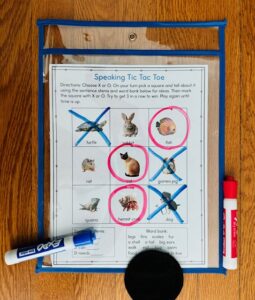
Honestly, I’m not sure how I taught for so many years without these dry erase pocket sleeves. They cut down on so much time spent on laminating! They save on colored ink too since you can print something once and use it many, many times. For games like Speaking Tic Tac Toe shown, I love to use colorful markers. It just adds to the engagement when students can choose their color. Don’t forget thin markers for writing and these make-up pad “erasers” too!
Here’s why this duo is especially powerful in an ESL classroom specifically:
Multilingual learners benefit enormously from low-stakes practice – activities where mistakes disappear easily and there’s no pressure to produce perfect written work. A dry erase pocket does exactly that. Students can attempt, erase, and try again without any anxiety about getting it “wrong” on paper.
Some of my favorite ways to use dry erase pockets with ESL students:
Reading practice: Slip in a passage or story, students can underline vocabulary, annotate, or circle words that follow a phonics pattern and erase for the reread.
Speaking games: The Tic Tac Toe game shown above is one of my most-used resources – students practice speaking prompts and mark their square. The colorful markers make it feel like a game, not a worksheet.
Sentence frames: Slip in a sentence frame card and students write their own sentence using the frame as a guide. They can erase and try a different sentence without wasting paper.
Quick checks: Use as mini whiteboards during whole-group instruction — students write answers and hold them up. Instant formative assessment.
The makeup pad erasers are my secret weapon here – they erase cleanly and last forever. Keep a small basket of them next to your marker bin and students can self-manage. They are also super easy to throw in the washing machine when they need it, you can’t tell is your students write on them, and they are inexpensive.
Essential Classroom Supplies Duo #2
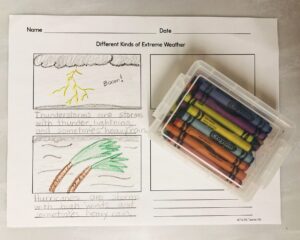
Crayons, and these boxes that fit 24 crayons perfectly, are also an awesome duo! The boxes help prevent breakage and crayons getting lost. It makes for easy cleanup and independence too! I send students to my drawer to grab a box when they are ready. They get a little movement and I can keep circulating.
This sounds like a simple supply but the organizational system it creates is genuinely useful in a busy ESL classroom. Here’s a deeper reason this duo earns its place:
ESL students, especially newcomers and younger learners, thrive on predictability and independence. When supplies have a clear home and students know exactly how to get them and put them away, it reduces the number of directions you have to give, which means more time for language learning.
A few practical tips:
Label the boxes with student names or group numbers if you feel it’s necessary. I did at first, and now all my groups share the same boxes to cut down on the cost.
Color coding by group is a natural extension — red group has red boxes, blue group has blue. Students can manage this completely independently after the first week if you prefer this type of organization.
Crayons specifically (vs. markers) are worth it for ESL vocabulary and drawing activities: they don’t bleed through thinner paper, dry out, or create the “I need a new marker” interruptions that pull you away from teaching.
Essential Classroom Supplies Duo #3
I know – these seem obvious. But hear me out, because scissors and glue sticks are especially important in an ESL classroom for reasons that go beyond basic craft projects.
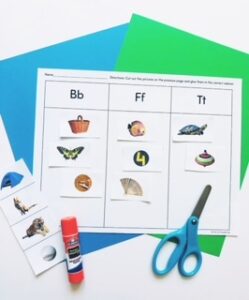
Cut-and-sort activities are one of the most effective and accessible formats for multilingual learners at any proficiency level. A student who can’t yet read a full sentence can still sort picture cards by category, cut and sequence a story, or match words to images. The physical manipulation of cutting and gluing keeps hands busy and anxiety low while language learning happens quietly in the background.
High-value ESL activities that use this duo:
Cut-up sentences: Students arrange words into a sentence and glue them in order. Builds syntax awareness without requiring writing from scratch.
Picture sorts: Sort by beginning sound, category, or vocabulary set – then glue to record the sort. Works across all proficiency levels.
Story sequencing: Cut apart panels of a simple story and glue in the correct order. Great for reading comprehension with minimal language demand, but also great for retelling stories when students are ready.
Word-to-picture matching: Cut pictures and words apart, match them, then glue. Vocabulary reinforcement that feels hands-on.
One practical note: buy more glue sticks than you think you need. They dry out, they disappear, and students go through them fast during busy project weeks. A 30-pack bought in August will hopefully last you a bit!
Duo #4
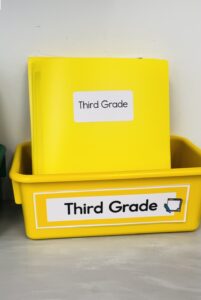
I’ve mentioned this before, but I love plastic folders for their durability and a great bin to store them in too! You can buy multiple of one color or a rainbow assortment of both folders and bins.
Organization is one of those things that feels invisible when it’s working and catastrophic when it isn’t. For ESL teachers who see multiple groups of students throughout the day, often in short back-to-back sessions, having a simple, foolproof folder system is essential.
Why plastic over paper folders: Paper folders get torn, bent, and destroyed within a few weeks, especially with younger students. Plastic folders last the entire year and beyond. I’ve had some of mine for three years or more. The slightly higher upfront cost pays for itself immediately.
How I use the bin + folder system:
Each student has their own folder in the bin, organized by group
Completed work, notes home, and ongoing projects all live in the folder
When a student arrives, they grab their folder independently – no transition time lost
When they leave, work goes back in the folder and returns to the bin
For push-in teachers or those without a dedicated classroom, this system travels. A handled bin with folders fits neatly on a cart and moves between rooms without anything getting lost or mixed up.
Duo #5
I love a great anchor chart, don’t you? These markers last a long time for me and the chart paper sticks like a giant sticky note so I can move it around the classroom.
Anchor charts are only as useful as their accessibility – a chart rolled up in a corner or stored in a closet isn’t helping anyone. The sticky easel pad solves this completely. Charts stay up while they’re relevant, move when you need them to, and come down without damaging walls. For a traveling ESL teacher, this is especially valuable.
What makes a great ESL anchor chart:
Always include visuals alongside text – a student at the early proficiency level can use a chart with pictures even before they can read the words
Build it WITH students when possible – a chart students helped create is more memorable than one you made at home
Keep it to ONE concept per chart – a crowded chart loses everyone
Sentence frames and speaking stems make particularly powerful anchor charts – students can glance up and use them independently during speaking and writing
The Mr. Sketch scented markers are worth calling out specifically: the colors are vivid, they photograph well for Instagram (😄), and students genuinely get excited when they see them come out. Small things that add to engagement matter.
Honorable mention duos
I have to add a couple bonus duos that I love!
Color paper and magnetic circles to hang them on the whiteboard.
Sentence strips and sharpies.
Sticky notes and flair pens.
Don’t want to go the year without them!
A Note for Push-In and Cart Teachers
If you don’t have your own classroom, your supply list looks a little different – but the same principles apply. Here’s what essential ESOL classroom supplies I’d prioritize if everything had to fit on a cart or in a bag:
Dry erase pockets are your number one friend – they’re flat, lightweight, and turn any printed resource into a reusable activity
A handled storage bin (like the one in Duo #4) keeps folders organized and travels easily
One pouch of markers and a small set of crayons per group — enough to do the job without weighing you down
Glue sticks and a few pairs of scissors in a pencil pouch so they’re always with you
You don’t need a perfect classroom to create a great learning environment. You need good materials, a clear system, and the confidence that you’ve got what you need.
These five duos have genuinely changed how smoothly my ESL classroom runs – not because they’re fancy, but because they’re the right tools used intentionally. I hope at least one of these pairs makes it onto your back to school list this year.
All essential ESOL classroom supplies are linked to my Amazon storefront here – these are affiliate links, so I may earn a small commission at no cost to you. The classroom activity photos throughout link to the related TPT resources if you want to see how I use these supplies in real lessons.
More posts to help you get ready for back to school:
Come find me on Instagram and TikTok – I share real classroom photos, quick tips, and behind-the-scenes peeks at how I use all of these supplies with actual students!
Happy Teaching!
Beth
Welcome! You are in the right place if you are looking for teaching ideas and resources to support your young English learners.
We use cookies to ensure that we give you the best experience on our website. If you continue to use this site we will assume that you are happy with it.